Rehabeat
A phone, a TV and wearable sensors that guide amateur athletes through rehabilitation at home, with music setting the pace.
- Role
- End-to-end UX designer
- Team
- 4 design students
- Timeline
- Oct 2024 – Jan 2025
Overview
Problem
Recovering at home, injured athletes can’t tell whether they move correctly, and repeating exercises in silence wears motivation down.
Approach
Clinical literature, physiotherapy protocols and a heuristic review of fitness apps, then a system built across three devices.
Outcome
A phone app, a TV coach and wearable sensors: a plan from the medical report, live form correction, music matched to every exercise.
- Role
- End-to-end UX designer
- Timeline
- Oct 2024 – Jan 2025
- Team
- 4 design students
- Type
- Connected health system
- Platform
- iOS app + TV + sensors
- Tools
- Figma, FigJam
Result
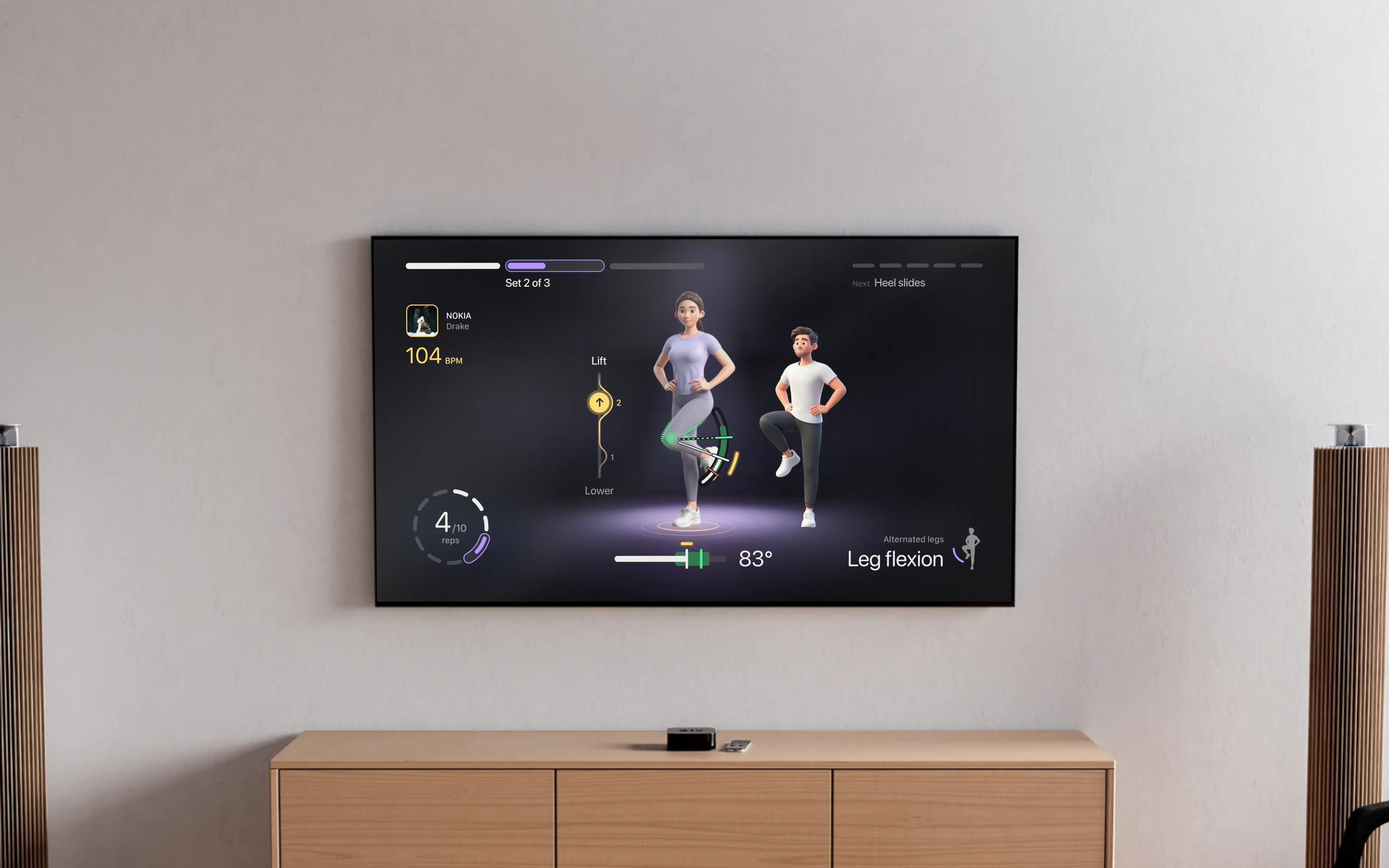
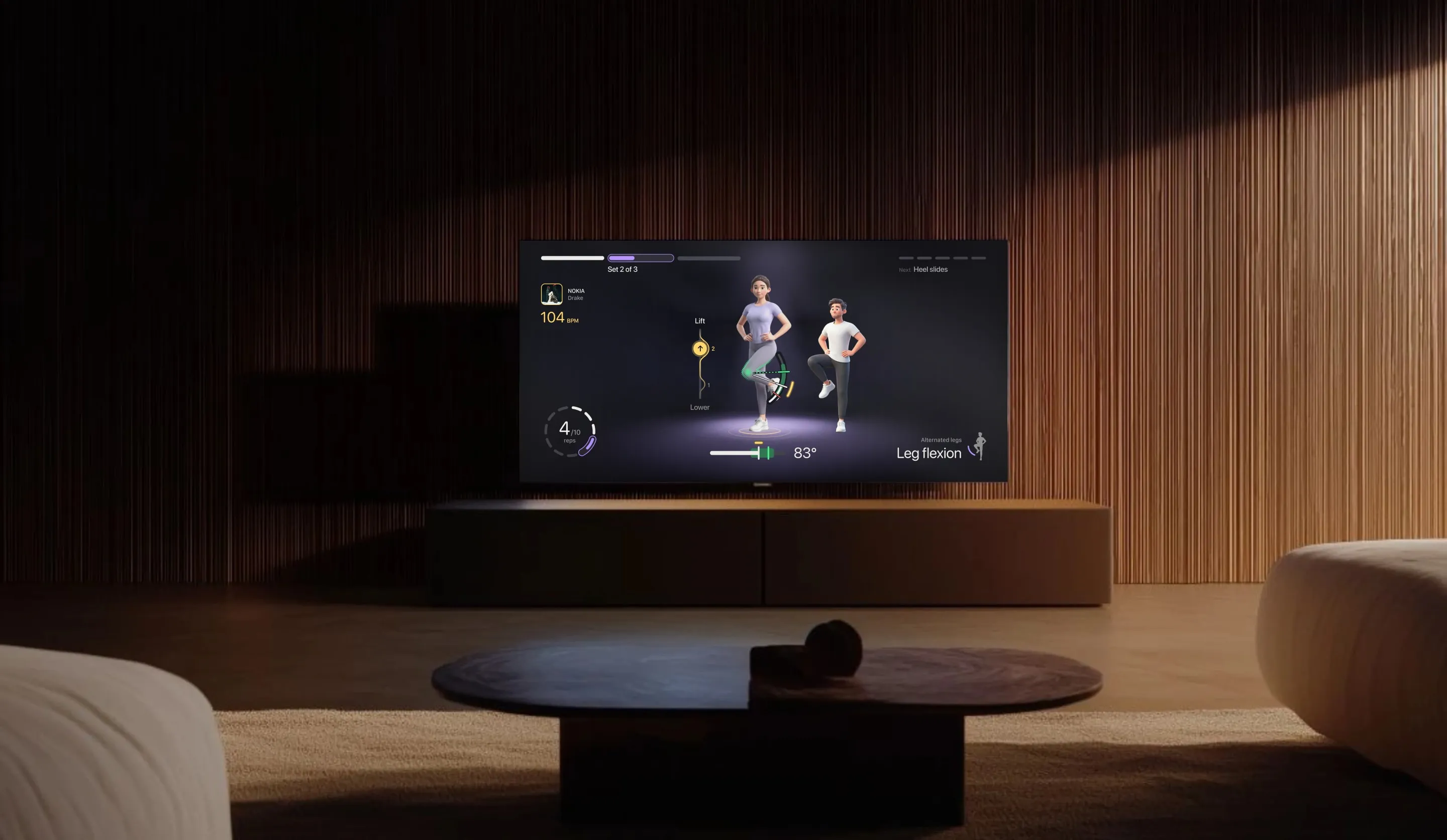
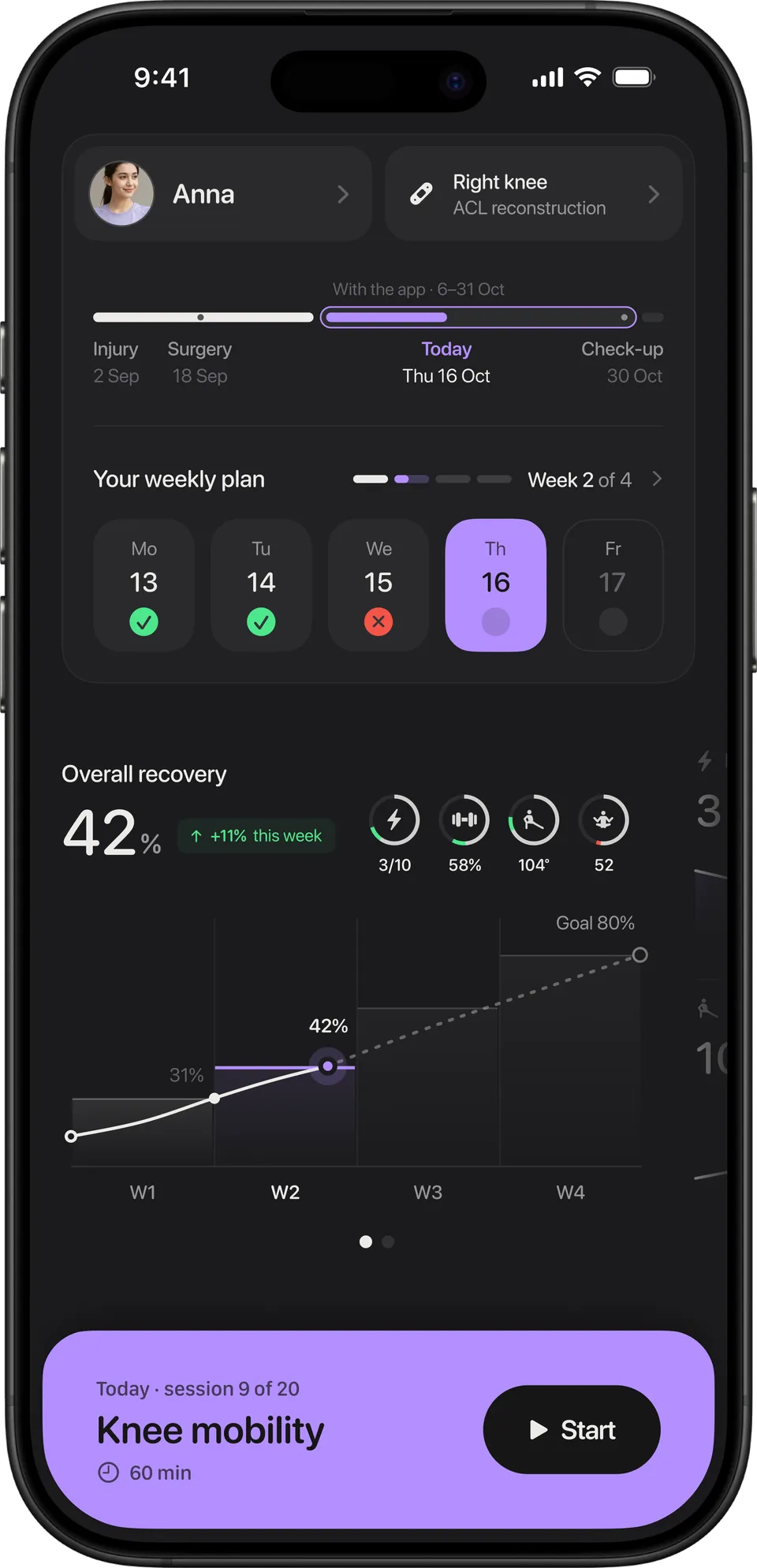
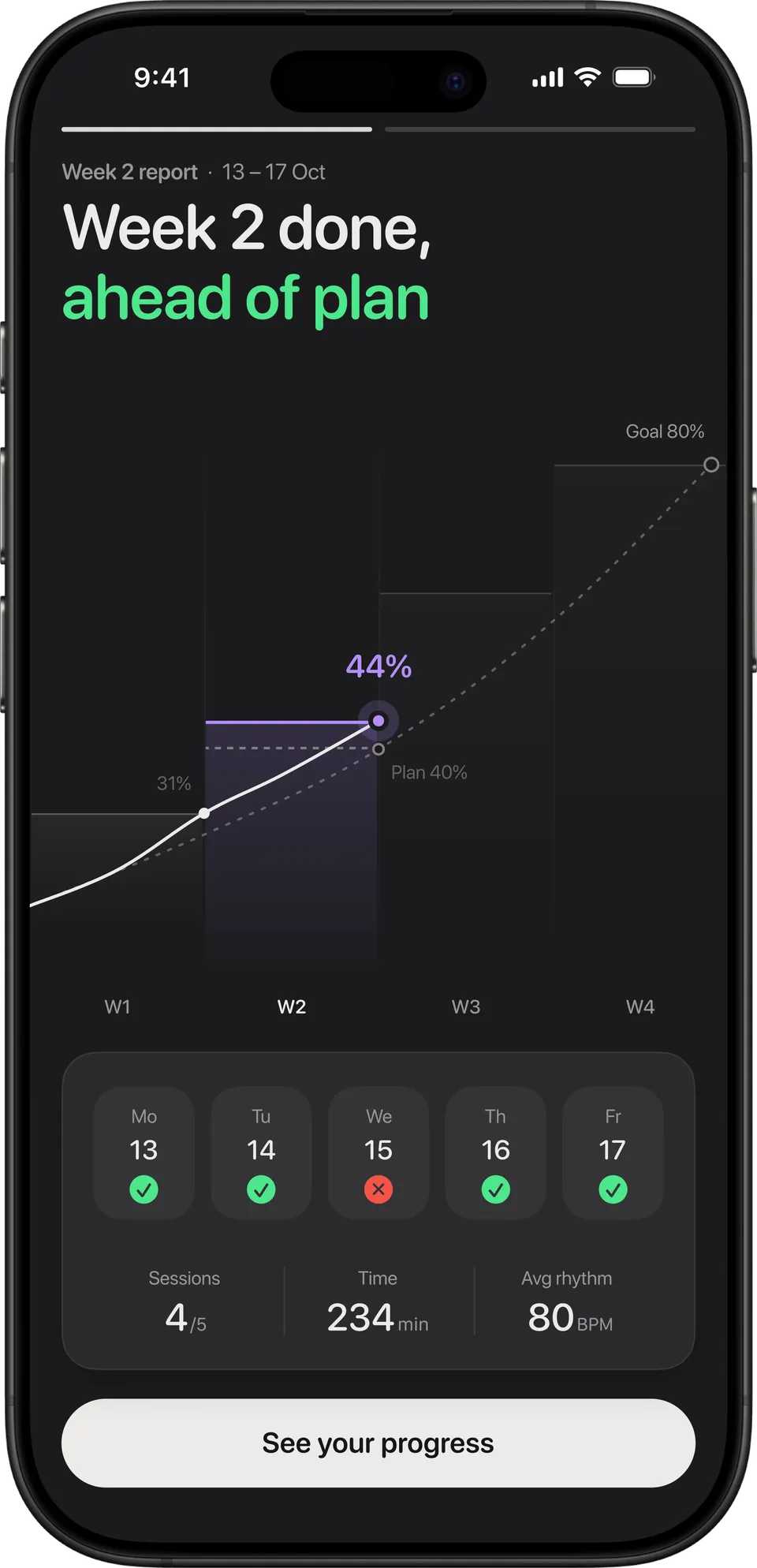
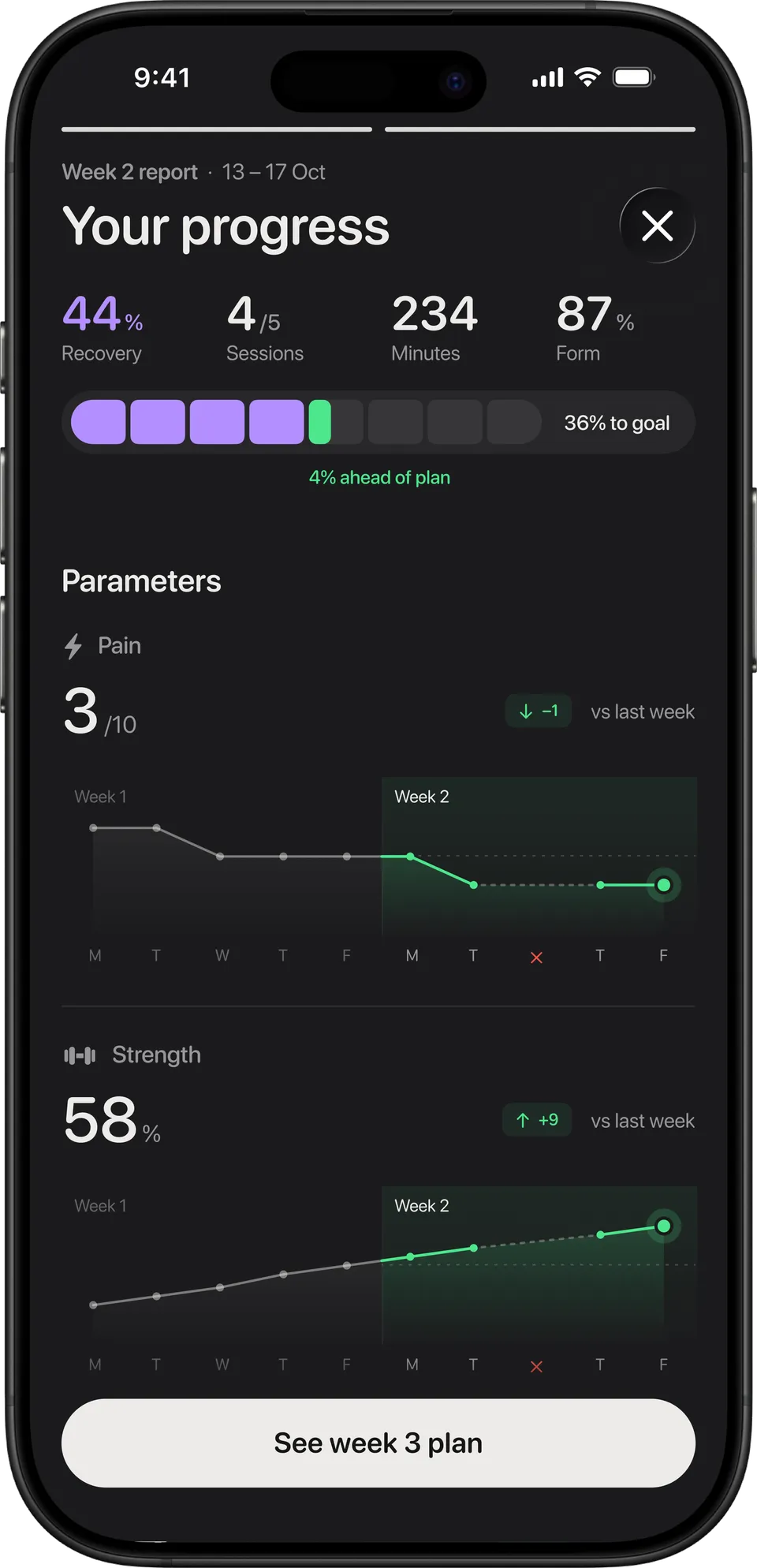
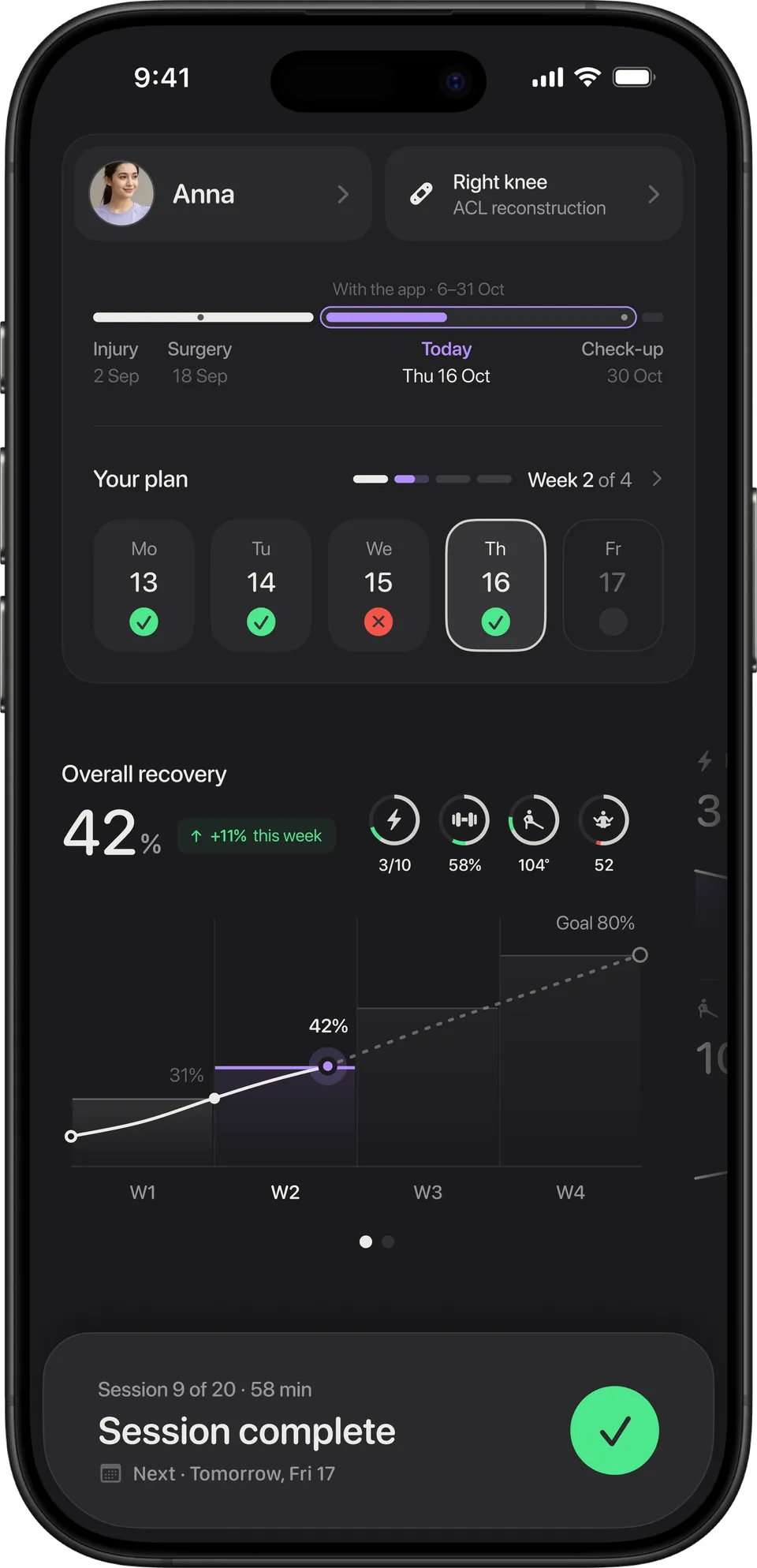
The phone turns the medical report into a weekly plan; the TV becomes the coach, mirroring every movement and correcting it live; the music sets the pace of each exercise.
01The coach on the TV
02The app
03Before and after a session
The system
- Synced devices: phone, TV and sensors
- 3
- Check-in questions after every workout
- 4
- Plan recalibration every week, from sensors and ratings
- 1
Process
Challenge
Recovering from a sports injury at home means exercising alone, with nobody to say whether a movement is right.
The brief, for a human–computer interaction course at the University of Trento: help amateur athletes return to their sport after an injury, safely and without making it worse.
A team of four over one semester. I worked on every phase, from research to the app and TV interfaces.
The evidence
of athletes return to their pre-injury level of sport after ACL reconstruction.
Source: Ardern et al., 2014 (69 studies, 7,556 participants)
The same review found that a positive psychological response favours the return: recovery happens in the head as much as in the knee.
- Don’t keep up their home exercise programme
- 30–50%
- Musculoskeletal patients (Argent et al., 2018).
- Studies link music to better mood and lower perceived exertion
- 139
- Meta-analysis, 3,599 participants (Terry et al., 2020).
The question
How might we give injured amateur athletes the eye of a physiotherapist at home, and a reason to keep going?
Research
We started from how rehabilitation is meant to work, then looked at where unsupervised tools fail.
Methods
- 01Clinical literatureRecovery after sports injuries, fear of re-injury and why people stop exercising at home.
- 02Physiotherapy protocolsHow exercises are prescribed, dosed and progressed after an injury.
- 03Heuristic reviewExisting fitness and rehab apps, checked for safety gaps when nobody supervises.
From the athlete’s side
From there we mapped needs and problems as the athlete lives them: what a safe recovery at home requires, and what gets in the way.
Needs
What a safe recovery at home requires.
- Exercises for the injured area
- Correct execution
- Visible progress
- Autonomy
Problems
What gets in the way.
- Little rehab knowledge
- Low motivation
- Generic plans
- Unclear progress
Insights
The exercises were never the problem. Doing them alone, unsure and in silence was.
01Nobody checks the movement
Without a therapist in the room, athletes can’t tell a right movement from a wrong one. The doubt feeds a fear of re-injury, and fear makes movements hesitant.
02Home exercises feel like a sentence
Prescribed exercises read as a reminder of the injury, not as training. Without progress or reward, repetition turns into a chore, and people stop.
03Generic plans miss the injury
Paper sheets and video tutorials are the same for everyone. A plan that ignores the specific injury slows recovery and raises the risk of a relapse.
04Progress is invisible
Without clear, regular feedback, athletes don’t know where they stand in their recovery, and the uncertainty leaves them frustrated and lost.
Define
Two archetypes drop out for opposite reasons: one is afraid of moving wrong, the other is bored of moving at all.
The target
Amateur athletes aged 18 to 50, recovering at home from a sports injury. Motivated to get back to their sport, busy with everything else, and keen on fewer visits and trips to a clinic.
The archetypes
Both are synthesised from the research above: two ends of the same problem, not two invented users.
Wants
In their words
Friction
Needs
Opportunity
The anxious perfectionist
WantsCertainty
In their words“I want to recover, but I am terrified of making a wrong move and hurting myself again.”
The bored achiever
WantsChallenge
In their words“I know what I have to do, but repeating the same exercises in silence is demotivating.”
Design principles
01Clinical precision, home comfort
The rigour of a supervised session, with the ease of a consumer product.
02Rhythm as a driver
Music is not background: its tempo sets the speed of each movement, so instructions become instinct.
03A mirror that corrects
Athletes have to see themselves to correct themselves, with instructions laid over their own movement.
Ideate
Euleria showed what sensors and game mechanics can do for rehabilitation. Its limit was who it is for: professionals, not patients.
What we kept and what we changed
01Kept: sensors
Precise movement data is what makes feedback worth trusting.
02Kept: game mechanics
Points and visible progress keep people going through repetition.
03Changed: who sets the plan
Euleria needs a professional to define it. Rehabeat starts from the doctor’s report and builds the plan itself.
04Changed: who reads the data
Clinical dashboards are hard to read without training. Progress has to make sense to the athlete.
Design
Three devices, one session: the phone plans, the TV coaches, the sensors watch, and the music keeps time.
The system
Four parts and what flows between them. The phone is the hub; the music travels with the session, from the plan on the phone to the TV.
The session, step by step
Five moments, from the doctor’s report to the end of the week.
- App: upload report and plan9:1401
From report to plan
Body data sets the safe limits; the athlete uploads the medical report, and the AI turns injury, area and recommendations into a weekly plan.
- TV: framing check16:902
Set up once
TV paired with a QR code, sensors over Bluetooth, connections remembered. The phone goes under the TV and both screens confirm the framing.
- App: track for the exercise9:1403
Music sets the pace
Each exercise gets a track whose beat matches the movement. A best fit is ready; the athlete can swap it for another song in the same tempo range.
 04
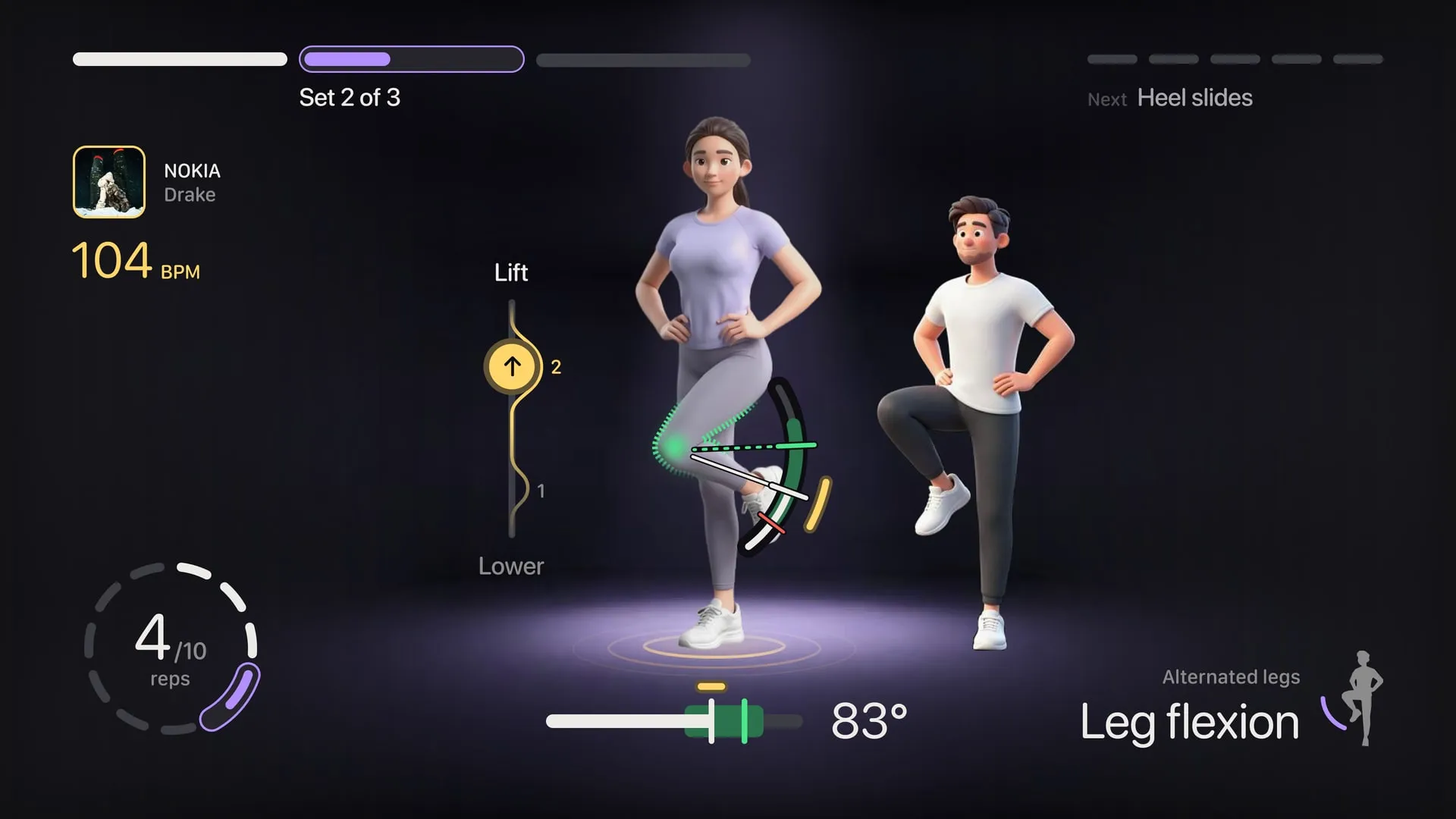
A coach on the TV
A live avatar mirrors every movement next to a guide figure. When form drifts, the correction appears on the avatar as it happens.
- App: weekly report9:1405
The week, measured
After each workout, four quick ratings: pain, fatigue, difficulty, mood. With the sensor data they feed a weekly report, and the plan adapts.
What it is designed to change
01Safer autonomy
Form errors caught in real time, so a session at home keeps the safety of a supervised one.
02Training, not treatment
Rhythm and game mechanics turn a medical obligation into a workout people want to finish.
03Measurable recovery
Range of motion and stability scores, set against how the athlete feels, replace guesswork with evidence.
04Lighter clinics
With execution checked remotely, physiotherapists could focus on the cases that need them in person.
Reflection
The brief looked technical. The real problem was emotional: fear on one side, boredom on the other.
What I learned
Sensors and AI were the easy part to imagine. What decided the design was confidence: a system that shows the athlete a movement is right, instead of just asking for it.
The music idea taught me to treat an emotional need as a functional one. Rhythm is not decoration here: it is the instruction.
If I started again
- Put the prototype in front of injured athletes before refining the screens.
- Bring in a physiotherapist from the first week, to check the exercises, the safety limits and what the AI may change.
- Test the music idea on its own, with a quick experiment on whether matching the beat really improves form and adherence.
Rehabeat is still a concept, designed in Figma. Its next step is a session with a real athlete and a real physiotherapist.
What I take with me
People keep going when they can see they’re doing it right.